
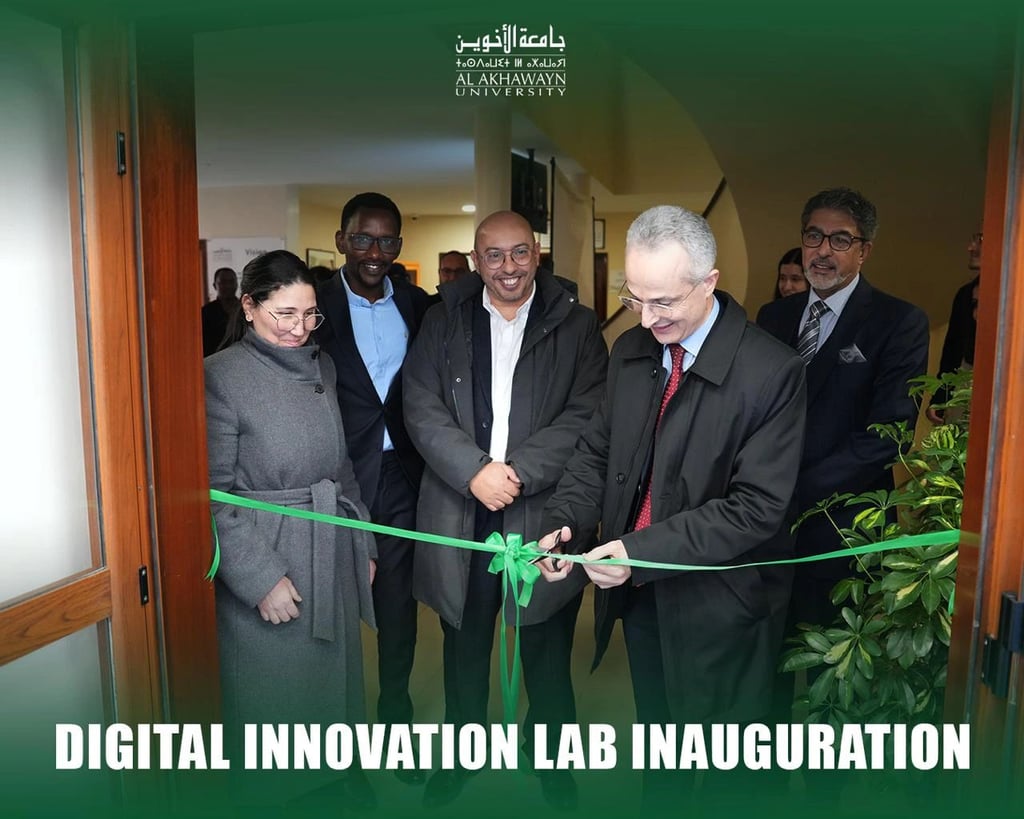
Al Akhawayn University has opened a new Digital Innovation Lab at its Ifrane campus, giving students and researchers a place to work on practical digital challenges facing Morocco and the region.
The Lab was inaugurated on 10th February and signals the university’s growing focus on digital public infrastructure, cybersecurity, and responsible AI.
The space is part of the UpanziNetwork, led by Carnegie Mellon University Africa, which connects institutions working on digital public goods and identity systems. Through the partnership, AUI expects to strengthen hands-on research and student projects linked to broader digital transformation efforts across Africa.
The Lab itself is set up as a working environment, rather than a formal research center. It includes shared workstations, large interactive screens, a small demonstration area, and flexible space to host workshops, meetings, and student presentations. The idea is to give teams somewhere they can test and build ideas, not just discuss them.
Representatives from the Open Government Partnership, Women in AI Morocco, and the Upanzi Network attended the launch event and spoke about the need to strengthen local expertise in digital identity, ethical AI, and cybersecurity.
The Lab is open to students from different disciplines and is intended to bring together public institutions, civil society organizations, and international collaborators.
Assistant Professor Houda Chakiri, who leads the initiative, said the Lab focuses on responsible AI and digital public infrastructure, including experimentation with platforms such as MOSIP. She described it as a space meant to connect academic work more directly with public needs and social challenges.
Work has already started on several digital innovation projects, including the RICER wildfire-risk prediction platform, early digital infrastructure prototypes built by students, and research into inclusive AI and innovation in public services.
Plans for the coming year include hosting the North Africa Digital ID Hackathon and organizing the AI & Society International Symposium, both expected to bring together researchers and practitioners working across technology and governance.
University leaders say they hope the lab will grow into more than just another campus facility, leading to the creation of student-built tools, research that feeds into key policy discussions, and partnerships that turn academic work into usable solutions beyond the university.
Professor Salah Al-Majeed, Dean of AUI's School of Science and Engineering, said the initiative reflects the university's intention to contribute to Morocco’s wider digital transition.
“We see AUI as having a role to play in the country’s digital future,” he noted, adding, "By working on areas like digital identity and cybersecurity, we hope to support both public institutions and industry as Morocco continues to modernize its digital systems."
For further information, please visit:
•Al Akhawayn University’s Digital Innovation Lab: https://dil.aui.ma/
• Carnegie Mellon University Africa’s Upanzi Network: https://www.africa.engineering.cmu.edu/research/upanzi/index.html